

Reading time: approximately 8 minutes.
Case hardening is one of the most serious defects that can develop during timber drying. It occurs when the outer layers of wood dry too quickly, creating internal stresses that may lead to distortion, honeycombing and machining problems. This page explains how case hardening develops, how the prong test is used to detect it, and how careful drying schedules help prevent both case hardening and collapse.
The most common method of monitoring drying stresses is the prong test. A U-shaped test piece is cut from the end of a board and observed immediately and again after 24 hours.
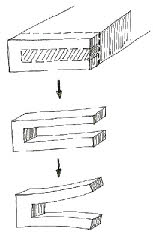
After standing for about 24 hours the prongs will now indicate whether the drying stresses were temporary or permanent.
Hopefully the arms of the prong will have straightened back out because the stresses in the material were not permanent. Kilning can continue.
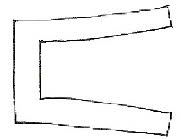
But if the prongs are found to have bent inwards the timber has unfortunately been case hardened. Kilning must be slowed down! We might even have to steam the timber.
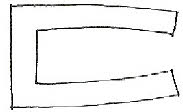
If the prongs are seen to have bent outwards then the defect of reverse case hardening has occurred.
Severe case hardening can cause another serious defect known as Honeycombing. This defect is only visible after resawing when checks are seen in the interior of the boards. oak, beech and eucalyptus are susceptible to this defect.
Collapse usually occurs if an attempt is made to dry wood that is at its maximum moisture content. As the air-water menisci recede into cells full of water they must pass through the very fine pores in the “pits” inter-connecting the cells, and this generates high tensile stresses in the water which causes the cells to implode. (the same mechanism is responsible for the “aspiration” – closing – of bordered pits).
The cells are especially prone to collapse if they are at high temperatures (more than 70 °C) when plasticisation of the cell wall material can occur. Collapse can lead to another defect known as:-
Wash-boarding is the visible surface distortion produced by collapse. Instead of a smooth surface, the timber develops a corrugated or rippled appearance. 0aks, eucalyptus, western red cedar are prone to collapse, especially if they are grown on very wet sites leading to thin walled, weak cells.
To prevent collapse, the wood must be initially dried at cool temperatures (or air-season), since once the cells start to lose water collapse cannot occur. Sometimes it is possible to reform the imploded cells by steaming.
Currently, research is being carried out which aims to generate gas bubbles in the water in the cells so that these bubbles can expand rather than the cells collapsing. This may be achieved by diffusing chemicals such as urea into the wood or by generating air bubbles using reduced pressure or ultrasonic treatment.
Other seasoning defects can be caused by fungal or chemical stains:-
This will occur if suitable conditions arise for sufficient time:-
e.g.
Note:In these cases the strength of the timber might not be affected - but the value might well be!
Return to the main Timber Drying guide for an overview of drying principles, methods and common defects.
Timber Drying Explained: Methods, Principles and Defects
Or continue to: